Friday, June 22, 2012

Qumran

After our stop in Jericho, we went to Qumran, an archaeological site where the Dead Sea Scrolls were found.  The Dead Sea Scrolls were found in 1947 and are, what they believe to be the earliest surviving documents of biblical text. The texts themselves were written in Greek, Hebrew, and Aramaic.  After their discovery in 1947, the search for more scrolls began.  Over the next couple years, many more fragments were discovered.  The fragments/scrolls were written on parchment and some on papyrus. The site is located in the West Bank near the Dead Sea.  Some scholars believe that the Qumran ruins were where the Jewish sect, the Essenes lived.  They have found cemeteries (1,200 tombs have been found), Jewish ritual baths, cisterns, and hundreds of scrolls.  However, there is an archaeological debate as to whether the scrolls were written by the Essenes or that they were brought from Jerusalem.  One argument is that the theological doctrine does not match the Essenes according to documentation by Josephus. 
This site was amazing to see and to think that the scrolls were discovered fairly recently shocks me.  Later on in our trip, we were able to go to the Israel Museum and see some of the Dead Sea Scrolls. 


Pictures by Chloe Cooper and Aaron Harrison
Info from http://www.archaeology.org/online/news/qumran.html
http://www.bibleplaces.com/qumran.htm

Jericho

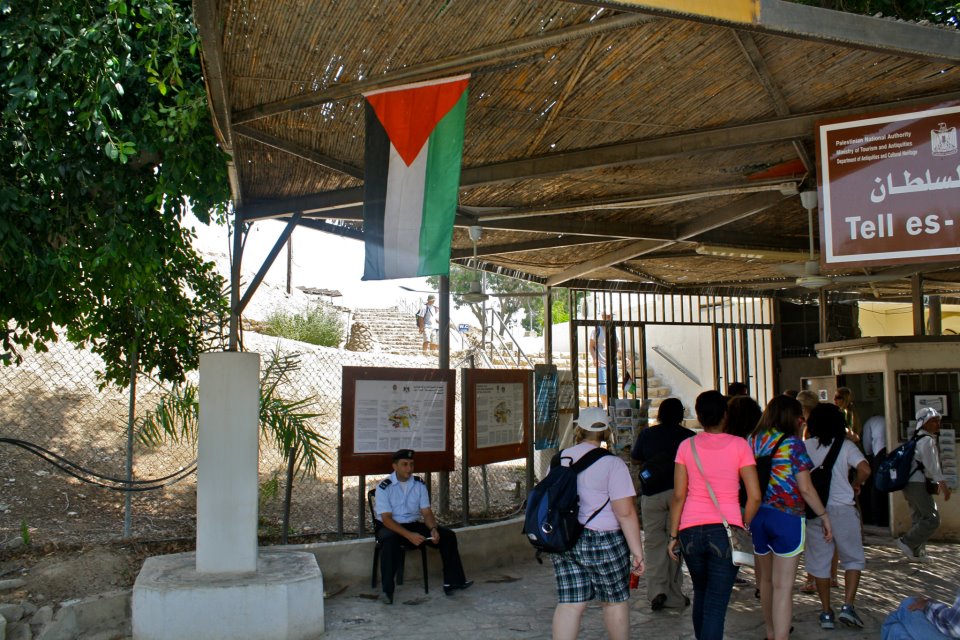
After staying in Haifa for a few days, we left for Jericho, which is located in the West Bank by the Jordan River.  Jericho is part of the Palestinian territories.  The purpose of our trip to Jericho was to visit, what they believe to be, evidence of a 10,000 year old town.  Interestingly enough, Jericho is the lowest, inhabited city on Earth.  Although our stop in Jericho was less than fifteen minutes, I still found this an important city to visit because of the Biblical history.  Then again, the whole country of Israel is full of biblical history...but I was excited to see the city where, according to the book of Joshua, the Battle of Jericho took place.  The Israelites tried to take over Canaan and succeeded by marching around the walls, blowing trumpets, and eventually the walls came tumbling down.  
Joshua 6 verse 1, 20, 21
Now the gates of Jericho were securely barred because of the Israelites. No one went out and no one came in.
20 When the trumpets sounded, the army shouted, and at the sound of the trumpet, when the men gave a loud shout, the wall collapsed; so everyone charged straight in, and they took the city. 21 They devoted the city to the Lord and destroyed with the sword every living thing in it—men and women, young and old, cattle, sheep and donkeys.


Wednesday, June 20, 2012

Jordan River

The Jordan River was another place I wanted to visit.  We weren't able to visit where John  baptized Jesus because the area wasn't safe, but just the idea that I was able to see the same river that Jesus was baptized in makes my faith seem more real.  The Jordan River is on the eastern side of Israel and flows into the Dead Sea.   The mention of the Jordan River is scattered throughout the Bible, but the most important story is Jesus's baptism by John the Baptist.

The whole Judean countryside and all the people of Jerusalem went out to him. Confessing their sins, they were baptized by him in the Jordan River. John wore clothing made of camel’s hair, with a leather belt around his waist, and he ate locusts and wild honey. And this was his message: “After me comes the one more powerful than I, the straps of whose sandals I am not worthy to stoop down and untie. I baptize you with[a] water, but he will baptize you with[b] the Holy Spirit.”

The Baptism and Testing of Jesus
At that time Jesus came from Nazareth in Galilee and was baptized by John in the Jordan. 10 Just as Jesus was coming up out of the water, he saw heaven being torn open and the Spirit descending on him like a dove. 11 And a voice came from heaven: “You are my Son, whom I love; with you I am well pleased.”12 At once the Spirit sent him out into the wilderness, 13 and he was in the wilderness forty days,being tempted[c] by Satan. He was with the wild animals, and angels attended him.

Mark 1:5-13


Sea of Galilee

The Sea of Galilee, the largest freshwater lake in Israel,  is a beautiful lake surrounded by fertile land.  As we were driving there, we saw many different fruit and vegetable plants, which made it evident of the area's fertility.  The Jordan River flows into the Sea of Galilee.  St. Peter's fish, also known as musht, is a type of fish only found in the Sea of Galilee.  The Sea of Galilee was where some of Jesus's ministry took place, as well as, some of his most famous miracles.  Visiting the Sea of Galilee was one of the most meaningful places we visited.  The reason being is that the setting was so believable because I could visualize Jesus during that time.  Most of the other important places had a church placed on top of the site, which made it difficult for me to visualize the events that happened their.  The Sea of Galilee is what it was back during Jesus's time.  This was an important site for my pilgrimage because I knew I was where Jesus had been.  Here are three places in the Gospels where the Sea of Galilee was mentioned.

Some time after this, Jesus crossed to the far shore of the Sea of Galilee (that is, the Sea of Tiberias), and a great crowd of people followed him because they saw the signs he had performed by healing the sick. Then Jesus went up on a mountainside and sat down with his disciples. The Jewish Passover Festival was near. John 6:1-4

Jesus Walks on the Water
16 When evening came, his disciples went down to the lake, 17 where they got into a boat and set off across the lake for Capernaum. By now it was dark, and Jesus had not yet joined them. 18 A strong wind was blowing and the waters grew rough. 19 When they had rowed about three or four miles,[b]they saw Jesus approaching the boat, walking on the water; and they were frightened. 20 But he said to them, “It is I; don’t be afraid.” 21 Then they were willing to take him into the boat, and immediately the boat reached the shore where they were heading.22 The next day the crowd that had stayed on the opposite shore of the lake realized that only one boat had been there, and that Jesus had not entered it with his disciples, but that they had gone away alone. 23 Then some boats from Tiberias landed near the place where the people had eaten the bread after the Lord had given thanks. 24 Once the crowd realized that neither Jesus nor his disciples were there, they got into the boats and went to Capernaum in search of Jesus. John 6:16-24
Jesus Calms the Storm
35 That day when evening came, he said to his disciples, “Let us go over to the other side.” 36 Leaving the crowd behind, they took him along, just as he was, in the boat. There were also other boats with him. 37 A furious squall came up, and the waves broke over the boat, so that it was nearly swamped.38 Jesus was in the stern, sleeping on a cushion. The disciples woke him and said to him, “Teacher, don’t you care if we drown?”39 He got up, rebuked the wind and said to the waves, “Quiet! Be still!” Then the wind died down and it was completely calm.40 He said to his disciples, “Why are you so afraid? Do you still have no faith?”41 They were terrified and asked each other, “Who is this? Even the wind and the waves obey him!”  Mark 4:35-41


We actually took a boat ride on the Sea of Galilee.  The boat was called the "Jesus Boat" and we enjoyed some American music and Israeli dancing.  Not was I was expecting, but it made for an interesting ride!


Tuesday, June 19, 2012

Capernaum, The Town of Jesus

Capernaum, is a village frequently mentioned in the Gospels  and is located on the north shore of the Sea of Galilee.  People resided there from the 1st century BC to the 13th century AD. It was a fishing village and also supposedly the home of Peter, Andrew (his first converts, Mark 1:21, 29), James, and John.  During this time, it was a Jewish village.  This town was a frequent place for Jesus's ministry.  I thought this was especially exciting to visit because of my familiarity with this town.  It is mentioned throughout the Gospels, which makes it an important site for one's pilgrimage. He preached after his temptation in the wilderness (Matthew 1:12-17), calmed the storm on the Sea of Galilee (Matthew 11:23-24), and healed a centurion's servant (Matthew 8:5-13).  The authenticity of the house of Peter, where Jesus stayed is very likely.  I thought the church built above it made it hard to visulize because of its modern architecture. The synagogue, from the Byzantine-era, is where Jesus was accosted by a demoniac while teaching there.  Capernaum was referred to Jesus's own city in Matthew chapter 9:1 and Mark chapter 2:1. 

In Capernaum, Jesus drives out an impure spirit. 
"21 They went to Capernaum, and when the Sabbath came, Jesus went into the synagogue and began to teach. 22 The people were amazed at his teaching, because he taught them as one who had authority, not as the teachers of the law.23 Just then a man in their synagogue who was possessed by an impure spirit cried out, 24 “What do you want with us, Jesus of Nazareth? Have you come to destroy us? I know who you are—the Holy One of God!”25 “Be quiet!” said Jesus sternly. “Come out of him!” 26 The impure spirit shook the man violently and came out of him with a shriek.27 The people were all so amazed that they asked each other, “What is this? A new teaching—and with authority! He even gives orders to impure spirits and they obey him.” Mark 1:21-28

Jesus also preached the sermon on the bread of life at the Synagogue.
35 Then Jesus declared, “I am the bread of life.Whoever comes to me will never go hungry, and whoever believes in me will never be thirsty.36 But as I told you, you have seen me and still you do not believe. 37 All those the Father gives me will come to me, and whoever comes to me I will never drive away. 38 For I have come down from heaven not to do my will but to do the willof him who sent me. 39 And this is the will of him who sent me, that I shall lose none of all those he has given me, but raise them up at the last day. 40 For my Father’s will is that everyone who looks to the Son and believes in him shall have eternal life, and I will raise them up at the last day.”  John 6:35-40


Background on Christianity 
Christianity is a monotheistic religion and was founded in the 1st century by the followers of Jesus Christ.  His followers believed Jesus Christ was the chosen one and Son of God who came to save us sinners by dying on the cross.  During his ministry, Jesus taught and healed those who followed him.  His teachings confronted the Jewish authorities and their fundamental beliefs, which caused both an uproar and a trickle of followers.  Eventually, Jesus was attracting crowds of people to hear what He had to say.  The canonical gospels in the Bible's New Testament consist of Jesus's life and teachings. 


I got my information from these two sites, as well as my NIV Bible.

The Basilica of the Annunciation in Nazareth

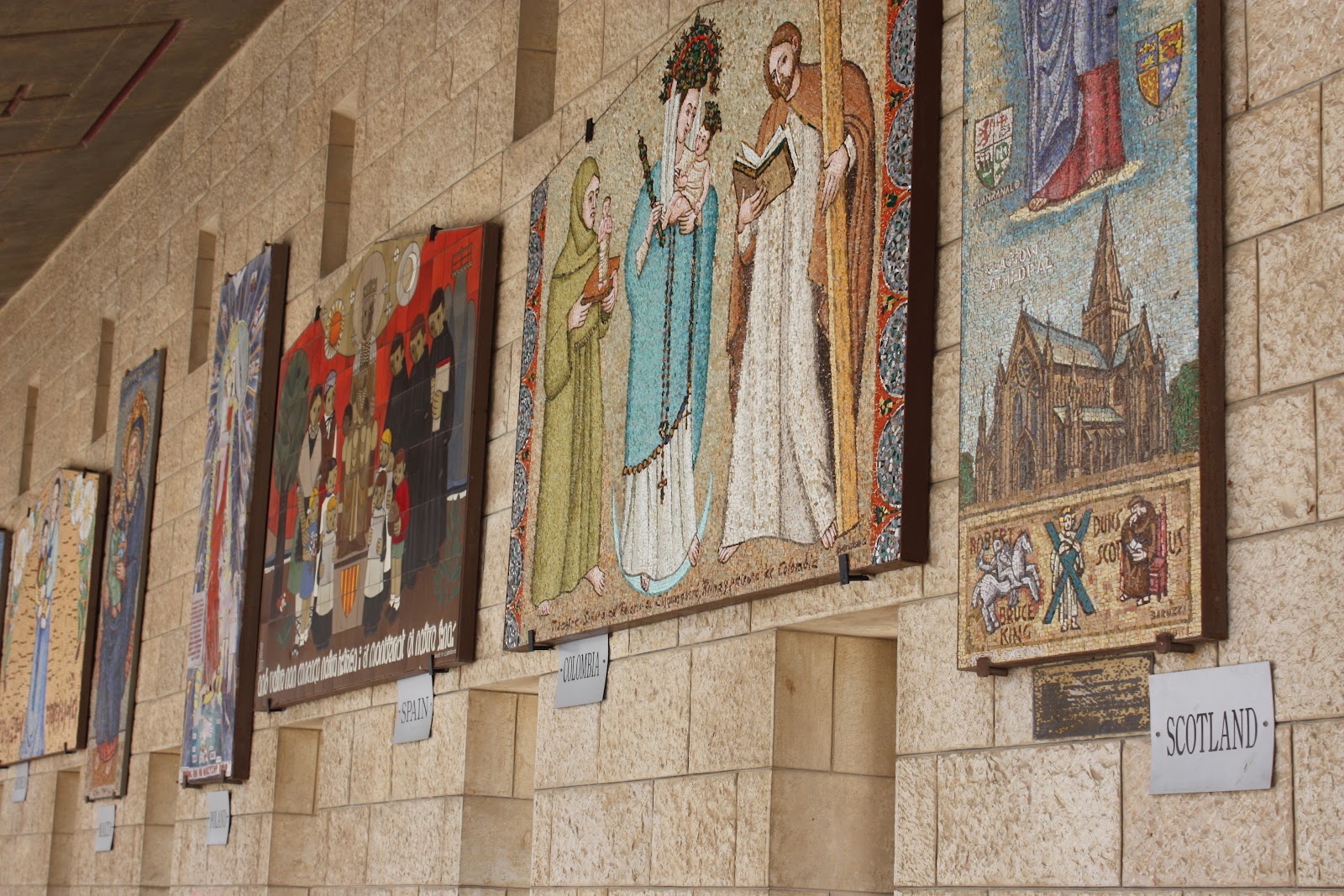
This church is where Catholics believe the Virgin Mary received the news from Gabriel that she would give birth to the Son of God.  My favorite part of this beautiful church was the depictions of Mary and the annunciation. 


In the above picture is the traditional site that the Catholic Church attributes to Mary and Joseph's house, as well as, the site of the Annunciation.

Photos taken by Aaron Harrison

The Synagogue Church in Nazareth

The significance of the Synagogue Church is that Jesus taught here in Nazareth.  Some believe this is where Jesus broke his silence and preached from Isaiah 61.  

16 He went to Nazareth, where he had been brought up, and on the Sabbath day he went into the synagogue, as was his custom. He stood up to read, 17 and the scroll of the prophet Isaiah was handed to him. Unrolling it, he found the place where it is written:“The Spirit of the Lord is on me, because he has anointed me, to proclaim good news to the poor.He has sent me to proclaim freedom for the prisoners and recovery of sight for the blind,to set the oppressed free,to proclaim the year of the Lord’s favor.”[a20 Then he rolled up the scroll, gave it back to the attendant and sat down. The eyes of everyone in the synagogue were fastened on him. 21 He began by saying to them, “Today this scripture is fulfilled in your hearing.”
22 All spoke well of him and were amazed at the gracious words that came from his lips. “Isn’t this Joseph’s son?” they asked. Luke 4: 16-22

Also, people responded angrily to Jesus at this location 

   28 All the people in the synagogue were furious when they heard this. 29 They got up, drove him out of the town, and took him to the brow of the hill on which the town was built, in order to throw him off the cliff. 30 But he walked right through the crowd and went on his way.  Luke 4: 28-30


Photos taken by Aaron Harrison